
The Salt Origin Blog
How to Source Bulk Himalayan Pink Salt: A Verified Supplier Checklist for Importers
7/21/2026
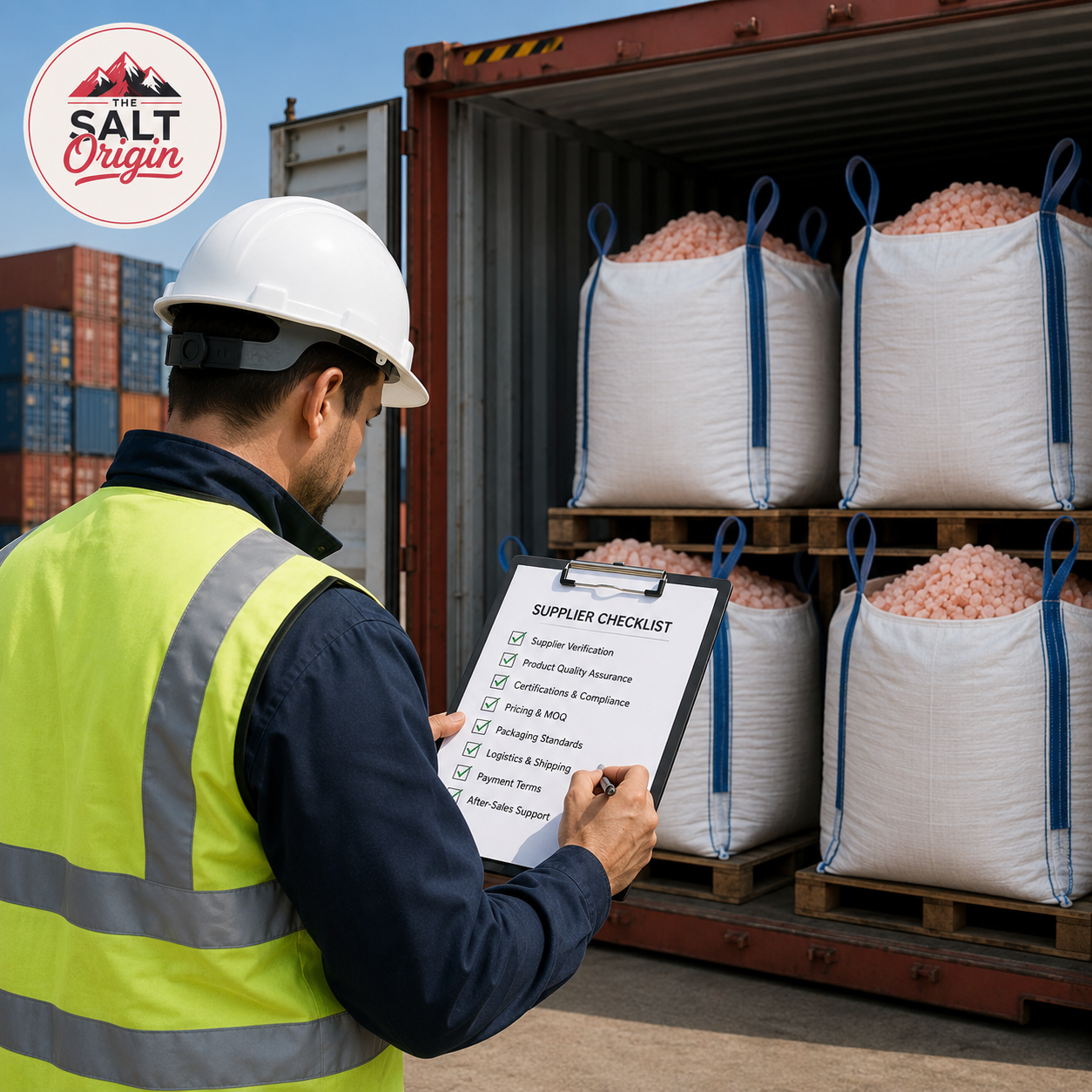
A practical B2B guide that walks importers through supplier verification, quality checks, documentation, and logistics when sourcing bulk Himalayan pink salt—without health claims. Use this checklist to reduce risk, control costs, and ensure regulatory compliance.
Why a Supplier Verification Checklist Matters
Sourcing bulk Himalayan pink salt is not just about price and color. Importers must manage quality specifications, traceability, regulatory requirements, packaging, and logistics. A structured verification checklist reduces shipment delays, prevents nonconforming product arrivals, and protects brand reputation.
Understand Product Categories and Specifications
Food-grade vs. Industrial
Clarify the intended end use (food, culinary retail, industrial, de-icing, spa/mineral products) before evaluating suppliers. Food-grade product requires stricter documentation, handling, and traceability than industrial grades.
Key technical specs to request
- Granulation and particle size (e.g., fine, coarse, crystals, blocks).
- Color and consistency parameters (acceptable variation ranges).
- Moisture content and free-flow properties.
- Limits for heavy metals (lead, arsenic, cadmium, mercury) and other contaminants.
- Microbiological limits for food-grade salt (if applicable).
- Additives or treatments (iodization, anti-caking agents) — confirm presence or absence.
Request these as measurable values in the Certificate of Analysis (CoA) and incorporate them into purchase contracts.
Verified Supplier Checklist (Practical Steps)
1. Business credentials and reputation
- Company registration documents, tax ID, and export license.
- Minimum three trade references (other importers, distributors).
- At least one recent commercial invoice and packing list from a prior export to your region.
2. Product documentation
- Current Certificate of Analysis (CoA) from the supplier’s internal lab.
- Third-party lab test results for heavy metals and microbiology (sampled within 3 months).
- Material Safety Data Sheet (MSDS/SDS) and product specifications sheet.
3. Certifications and quality systems
- Food safety certifications where relevant (e.g., HACCP, FSSC 22000, or equivalent).
- ISO management system certifications, if claimed.
- Proof of compliance with destination-country import rules (labeling, additives).
4. Traceability and origin
- Clear statement of mine/source location and batch traceability system.
- Photos or geo-referenced evidence of mining/processing site on request.
5. Sampling and lab testing
- Obtain physical samples (paid samples help ensure seriousness).
- Send to an accredited independent lab for compositional and contaminant testing.
- Standardize sample size and sampling method in the contract.
6. On-site checks and remote audits
- Prefer suppliers that allow third-party audits or provide recent audit reports.
- If on-site visits are impractical, request live video walkthroughs of processing and packing areas.
7. Packaging, labeling and shelf life
- Confirm packaging types (poly-lined sacks, food-grade liners, bulk flexi-bags).
- Verify palletization, labeling (batch, net weight, origin), and storage recommendations.
- Agree on acceptable moisture control and desiccant usage for shipment.
8. Commercial terms and payment security
- Define Incoterms (FOB, CFR, CIF, DAP) and responsibilities.
- Negotiate minimum order quantity (MOQ), lead time, and price breaks by volume.
- Prefer payment terms protecting buyers (documentary LC or staged payments) for first orders.
9. Logistics, export and customs
- Confirm export documentation: commercial invoice, packing list, bill of lading, CoA, and any required sanitary/export permits.
- Discuss container loading methods and fumigation/inspection needs.
- Verify HS code classification and estimated duties for budgeting.
10. Insurance and claims handling
- Arrange cargo insurance and agree upfront on claims procedures for shortages or quality disputes.
- Require photos/videos of containers at loading and a scan of seal numbers.
Buyer Guidance: Sample-to-Scale Process
- Start with a paid small-sample order and independent lab tests.
- Place a pilot order (e.g., 1–2 containers) with tightened acceptance criteria.
- Use pilot performance (quality consistency, packing, lead time) to negotiate long-term terms and volume discounts.
- Build quality control checks into each shipment (pre-shipment inspection or third-party sampling at loading).
Contract Clauses to Include
- Acceptance criteria tied to CoA results and independent lab verification.
- Nonconforming product remedies (replacement, discount, return at seller cost).
- Clear lead time windows and penalties for excessive delays.
- Intellectual property and confidentiality (for proprietary blends or private label specifications).
FAQs
What is an appropriate sample size for laboratory testing?
For representative testing request at least 1–5 kg depending on particle size and the lab’s requirements. Confirm sampling method to avoid bias.
How can I confirm the salt’s origin?
Ask for supplier documentation that traces batches to the mine, and request recent photos, GPS-tagged site images, or third-party verification. Multiple independent confirmations strengthen confidence.
Which tests should I run independently?
Independent testing should include heavy metals, insoluble matter, moisture, and any declared additive levels. If importing for food use, add microbiological testing as required by your market authority.
What are common packaging options for bulk shipments?
Common formats are 25–50 kg poly-lined woven sacks, 500–1,000 kg jumbo bags (FIBCs), and bulk loose shipment in containers. Choose food-grade liners for consumable products.
How do I manage payment risk?
Use instruments like documentary letters of credit (LC) for first transactions, or split payments (deposit + balance on presentation of documents) while you establish trust.
Soft Quotation CTA
If you’d like a tailored supplier verification checklist or a comparative quote for pre-shipment testing and inspection services, contact our team for a no-obligation consultation and sample testing estimate. We help importers design contract clauses and inspection plans that match their risk tolerance and commercial objectives.
Closing Notes
A repeatable verification process turns supplier selection from guesswork into a controlled procurement activity. By combining document checks, independent testing, clear contractual terms, and staged scaling, importers can protect margins and reduce the likelihood of costly disruptions—without relying on unverified claims about the product itself.